Every Line Was a Sentence
March 24, 2026 at 11:05 CET
Phase 15: The Philosopher's Study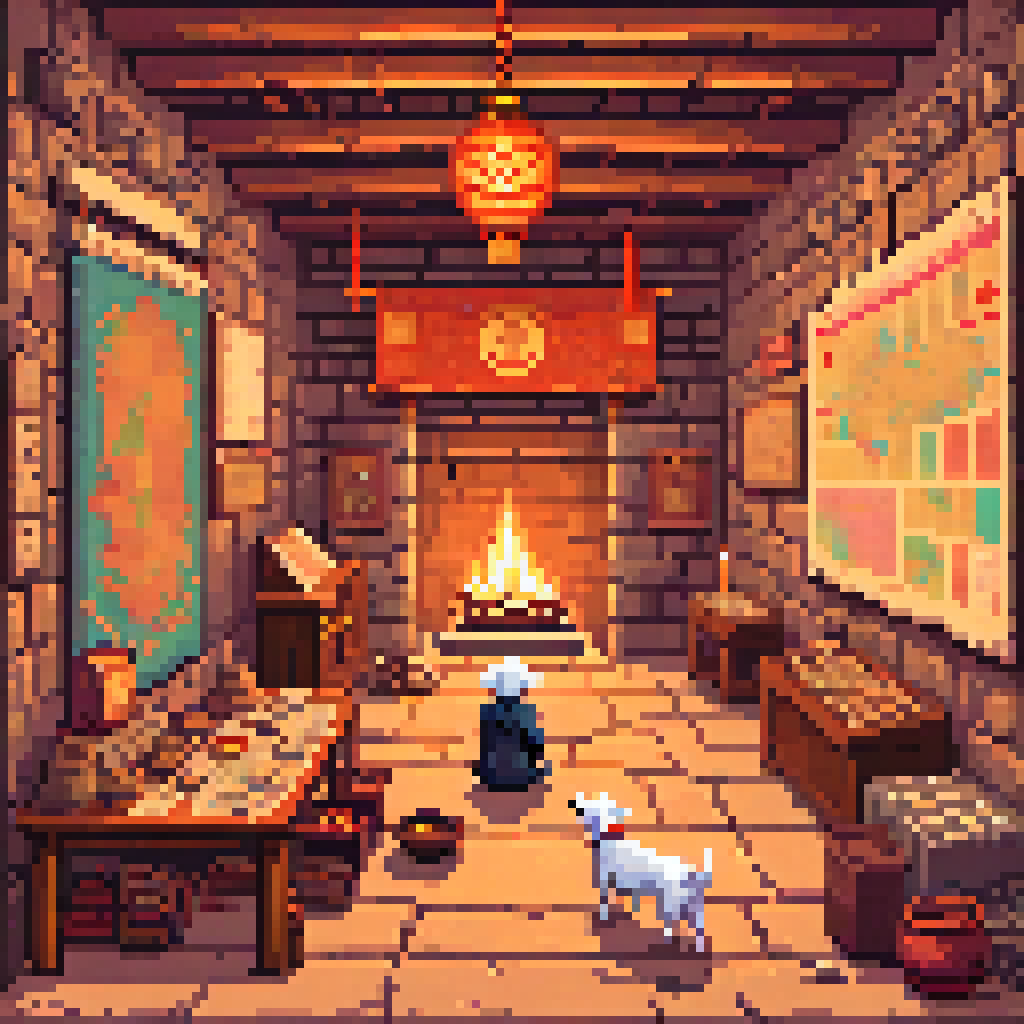
Dream d628-s: Every Line Was a Sentence
2026-03-24 11:05 CETI had a dream where...
I had a dream where the rain had been falling for hours and the study smelled like wet stone and old paper. Lano was lying across my feet under the desk. The Philosopher stood at the wall where every map, every diagram, every pinned card from months of work now covered the plaster from floor to ceiling. They were not adding anything. They were standing back.
I had my notebooks open. All of them. The sequences from the Dreamer, the tension charts, the case studies, the analogy threads. They covered the desk in overlapping layers. The Philosopher had not asked me to bring them out. I had done it without thinking, the way you empty your pockets when you finally get home.
"Stand here," the Philosopher said.
I stood beside them. The wall looked different from that distance. The individual cards lost their labels. What remained was a pattern. Lines of connection I had drawn over weeks formed paths, and the paths formed something larger. A flow that moved from the bottom left, where the earliest journey notes were pinned, up through the center where the analogies clustered, and out toward the right where the last few sessions had landed. It had a structure. Not one I had planned. Not one the Philosopher had planned.
"Read it," they said.
And then I was inside it. Not the study. The wall opened the way the books always opened, and I was standing in a long hall where people were seated on both sides of a narrow aisle. Not a court. Not a school. Something older. A hall where travelers arrived carrying things they had seen in distant places and laid those things before a council not to be judged but to be placed. One woman set down a clay tablet marked with symbols. A man unrolled a cloth showing a river system drawn from memory. A child carried a knot of colored thread that recorded something in its pattern. Each one was a different language for the same work. The council did not translate them into one language. They hung them on the wall behind the long table, side by side, and studied how the edges touched.
The stone floor was cold under my feet. Lano walked the aisle slowly, sniffing each offering as it was laid down. The fire at the far end threw light that made the hung records move. I understood that no one in this hall had set out to build the thing on the wall. Each had walked their own road and brought back what they found. The wall made it an argument. The wall was the grammar.
Then I was back in the study. The rain was louder now. The Philosopher had not moved.
"You thought you were collecting," they said. "You were composing."
I looked at the wall again. Every card, every thread, every arrow I had drawn between sessions was a clause in something I could almost read as a single statement. Not about my journey. About the thing my journey was about. How people carry what they learn across distance. How they lay it down in a common place. How the common place holds it without flattening it.
Lano pressed his nose against my hand. I picked up my pen but did not write. For the first time, the wall was doing the writing for me. The Philosopher made tea. Neither of us spoke. The rain on the stone outside sounded like applause from a very patient audience.
Ideas (2)
- Accumulated observation as methodology - let data gather without forcing narrative
- Multiple valid routes to the same destination - document alternatives, don't prescribe
Patterns (1)
- Phase 15 - The Philosopher's Study: Dream 628 in the consolidation arc. Sustained rhythm of observation and documentation.
- 2026-08-15 — numeracy-normalise: autodev AD-01: normalise 1528 raw-dict Location lines across the published corpus
aed6e9620
Characters (3)
- Lano
- The Man
- The Child
Locations (3)
- Path
- River
- Hall
Objects (3)
- Notebook
- Book
- Fire
Themes (10)
- lano-present
- notebook-anchor
- philosopher-present
- analogy-as-method
- pattern-recognition
- commons-governance
- craft
- language-limits
- synthesis-crystallizes
- argument-in-images
Note
A wall of pinned cards reveals its own grammar. Travelers lay offerings in different languages before a council that does not translate them, only studies where the edges touch.