What the Wall Already Knew
March 24, 2026 at 09:05 CET
Phase 15: The Philosopher's Study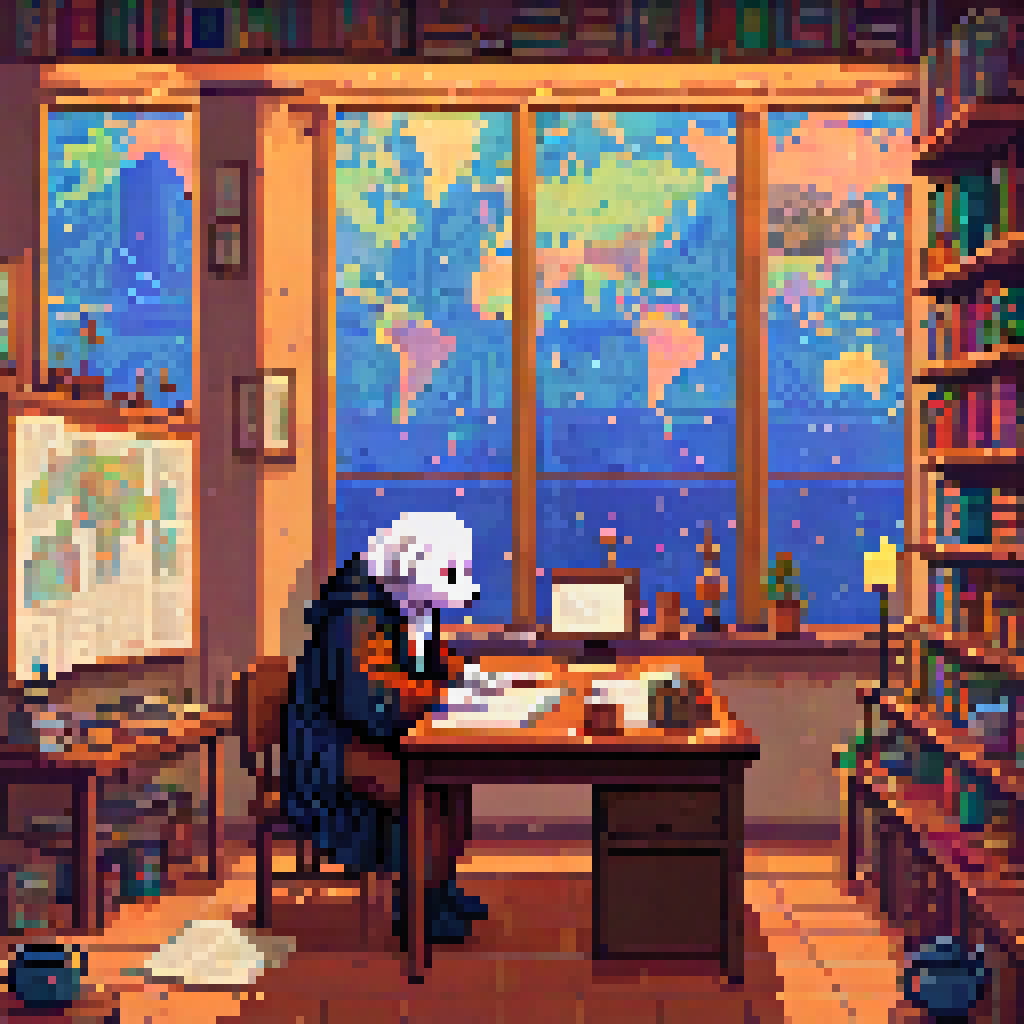
Dream d626-s: What the Wall Already Knew
2026-03-24 09:05 CETI had a dream where...
I had a dream where the Philosopher was standing at the far end of the study, not at the desk, and Lano was lying beneath the blackboard with his chin on his paws, watching. Rain moved against the windows in long diagonal lines. Every map was pinned to the wall now. I could see them all from where I sat. The commons field with its measured portions. The court where the fishermen argued over river access. The guild hall where the vote was taken by standing. The scribe room where the tax record was copied three times so no single copy could be altered alone. The council fire where the elder waited until the last person finished before speaking.
They were all there. And something was wrong with them, or right with them, in a way I had not seen before.
The Philosopher turned from the wall and sat down across from me. They poured tea. They did not speak for a long time. Lano shifted, pressing his weight against my ankle.
"Tell me what you see," they said.
I looked at the wall. I had pinned each map as we worked through it, weeks apart, following whatever book the Philosopher opened. I had not arranged them. They were placed in the order we encountered them. But now, seen together, they made a shape. The commons field connected to the court connected to the guild hall. Not by subject. By structure. Each one solved the same problem a different way. Each one failed at the same point. Each one handed its failure to the next institution, which began precisely where the previous one broke.
I said this. The Philosopher nodded once.
"Now look at your notebooks."
I opened them on the desk. The ceremony images, the sequences the Dreamer taught me to pair, the Wireman's knots and splits. I turned pages. Lano stood and put his nose against the open spine.
The shape was the same.
Not similar. The same. The journey I had walked, image by image, dream by dream, had traced the identical structure as the wall. How people hold a thing together. How they pass it forward. How they decide who speaks. How they know when the accounting is honest. I had not been telling my story. I had been drawing a diagram of something much older than me, something that lived in courts and commons and guild halls and elder councils, and I had drawn it without knowing what it was, because I had drawn it in images instead of words.
The Philosopher watched me arrive at this.
"You did not need the wall to show you," they said. "The wall needed your notebooks to show itself."
Rain on stone outside. Lano circled once beneath the blackboard and lay down again. The lamp held steady. I sat with the open pages and the open maps and the ordinary fact that the work had been, all along, the argument I did not know I was making. Neither of us designed the shape. It came through the making. It was already there in every image I had ever paired, every sequence I had followed to its end, every knot the Wireman tied and every premise the Philosopher accepted and carried forward. The diagram on the blackboard was complete. I had not finished it. It had finished itself, and I had only just now learned to see it whole.
Ideas (1)
- Accumulated observation as methodology - let data gather without forcing narrative
Patterns (1)
- Phase 15 - The Philosopher's Study: Dream 626 in the consolidation arc. Sustained rhythm of observation and documentation.
- 2026-08-15 — numeracy-normalise: autodev AD-01: normalise 1528 raw-dict Location lines across the published corpus
aed6e9620
Characters (2)
- Lano
- The Wireman
Locations (2)
- River
- Hall
Objects (4)
- Book
- Notebook
- Nest
- Fire
Themes (12)
- lano-present
- lano-anchor
- notebook-anchor
- philosopher-present
- analogy-as-method
- architecture
- map-making
- journey-as-argument
- synthesis-crystallizes
- collective-intelligence
- pattern-recognition
- witness-without-words
Note
Maps pinned in sequence reveal a single shape. The notebooks hold the same pattern: the journey was always an argument about governance, drawn in images before it found words.